Introduction
Digital signage has become a critical communication tool for businesses across retail, hospitality, healthcare, education, and corporate environments. When choosing a signage solution, organizations often face a common question:
Should we use USB-based signage or invest in a cloud-based digital signage platform?
While USB solutions may appear simple and affordable initially, modern businesses increasingly choose cloud-based signage because of its flexibility, scalability, and centralized management capabilities.
This guide explores both approaches and helps determine which option is best for your organization.
Understanding USB-Based Digital Signage
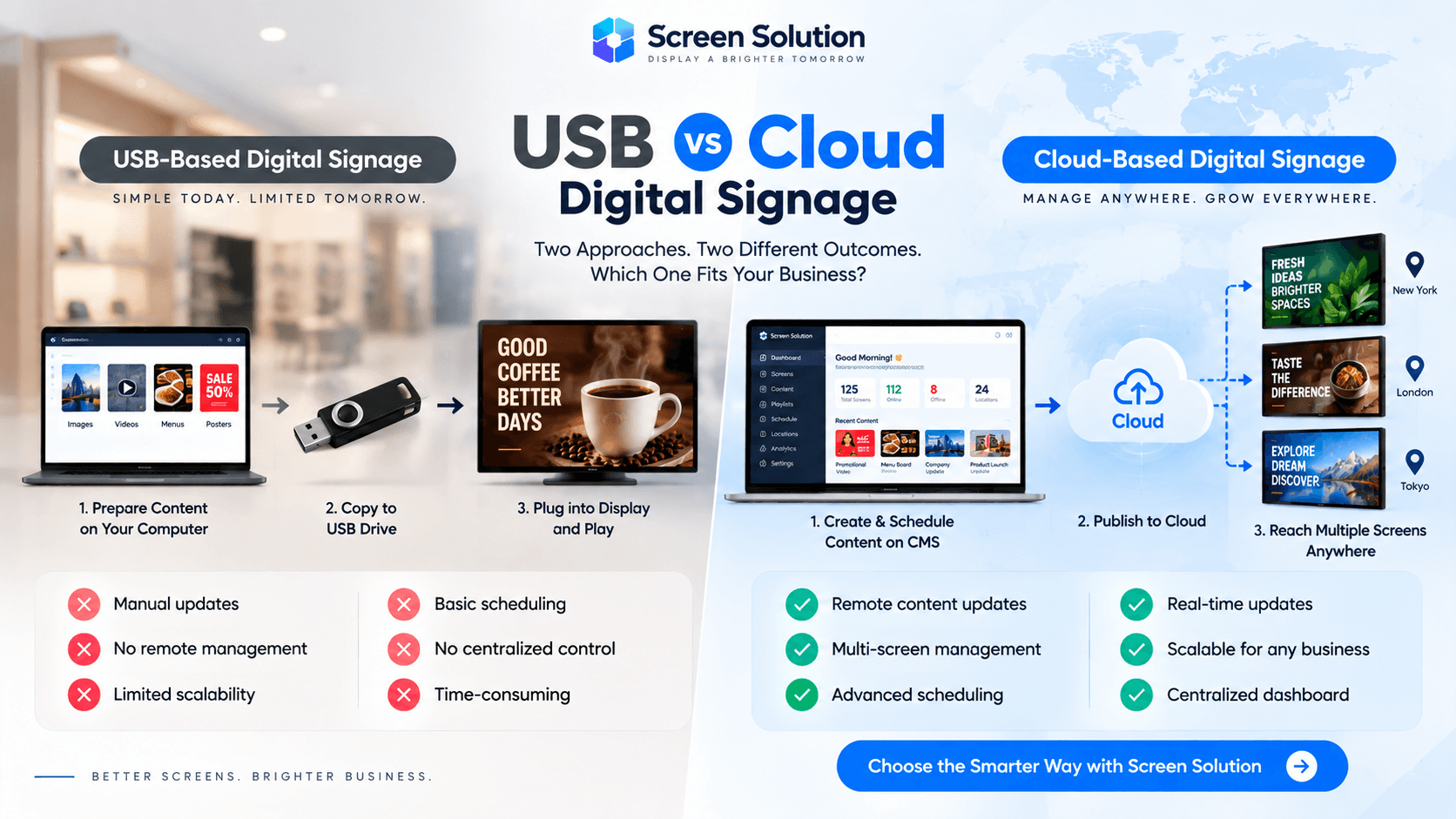
USB-based signage relies on manually copying media files onto a USB drive and connecting it directly to a display.
The screen then plays the content stored on the drive.
Advantages
Low initial cost
Easy setup
No internet dependency
Suitable for single-screen deployments
Limitations
Manual content updates
No remote management
Difficult to scale
Limited scheduling capabilities
No centralized monitoring
For businesses managing multiple locations, USB-based systems quickly become inefficient.
Understanding Cloud-Based Digital Signage
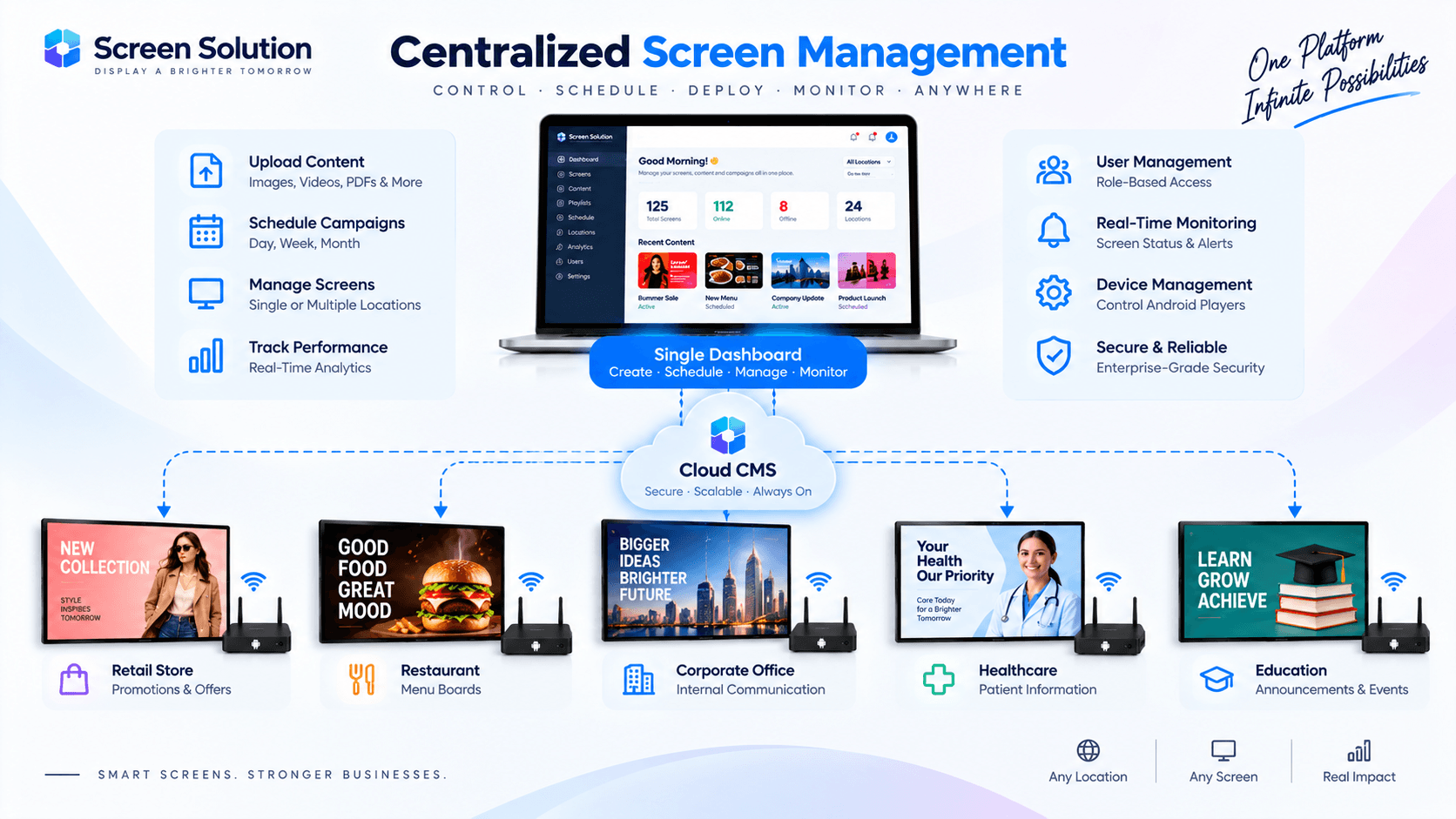
Cloud-based signage uses a centralized Content Management System (CMS) connected to digital displays through networked media players.
Administrators can create, schedule, and publish content from a single dashboard.
Advantages
Remote content updates
Multi-location management
Advanced scheduling
Real-time content changes
Device monitoring
User role management
Cloud signage significantly reduces operational effort while improving content consistency across locations.
Feature Comparison
Feature | USB-Based | Cloud-Based |
|---|---|---|
Remote Updates | ❌ | ✅ |
Multi-Screen Management | ❌ | ✅ |
Content Scheduling | Limited | Advanced |
Device Monitoring | ❌ | ✅ |
Scalability | Low | High |
User Access Control | ❌ | ✅ |
Centralized Dashboard | ❌ | ✅ |
Real-Time Updates | ❌ | ✅ |
Cost Considerations
Many organizations assume USB signage is cheaper.
However, operational costs increase as deployments grow.
For example:
Staff time spent updating content
Travel costs between locations
Inconsistent branding
Manual scheduling errors
Cloud signage eliminates many of these recurring costs through automation and centralized management.
Scalability Matters
A USB solution may work for:
Small stores
Single-location businesses
Temporary displays
However, organizations operating:
Retail chains
Restaurant franchises
Healthcare networks
Educational campuses
typically require cloud-based management to efficiently handle large screen deployments.
Reliability and Offline Playback
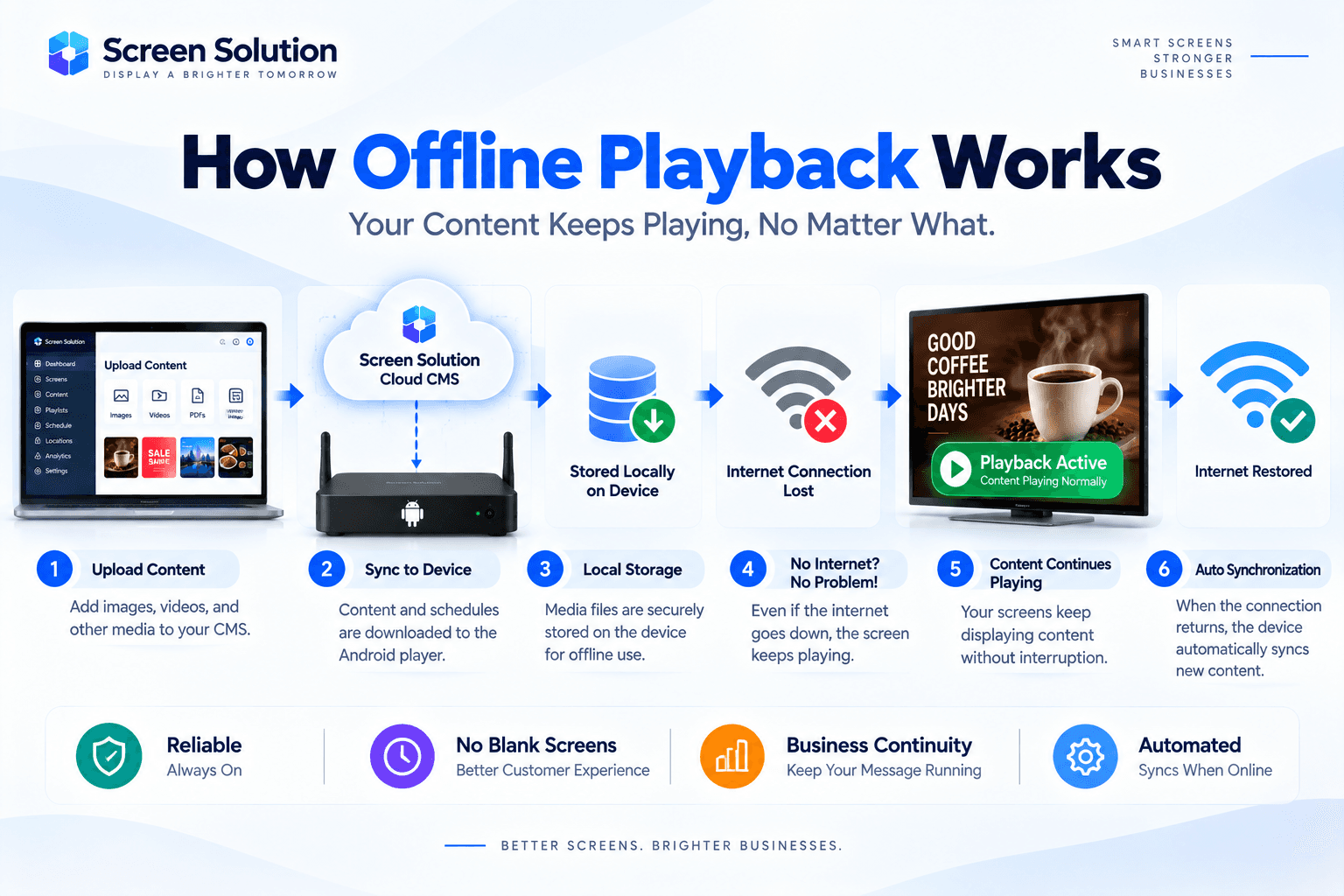
A common misconception is that cloud signage stops working when the internet connection is lost.
Modern Android signage players solve this issue through offline playback.
Content is stored locally on the device and continues playing even during connectivity interruptions.
Once the connection returns, the player automatically synchronizes updates.
This combines the reliability of local storage with the flexibility of cloud management.
Security and Control
Cloud-based platforms provide:
Secure user authentication
Role-based permissions
Device management
Activity tracking
Centralized administration
These capabilities are particularly important for enterprise deployments.
Real-World Example
Imagine a retail brand operating 50 stores.
With USB signage:
Staff must manually update each location.
With cloud signage:
Marketing teams update content once.
Changes automatically appear across all screens.
This saves significant time while ensuring consistent messaging.
Which Solution Is Right for You?
USB-based signage may be suitable if:
You manage one or two screens.
Content rarely changes.
Centralized control is unnecessary.
Cloud-based signage is ideal if:
You manage multiple displays.
Content updates frequently.
Scheduling is important.
Consistency across locations matters.
For most growing businesses, cloud-based digital signage offers superior efficiency, scalability, and long-term value.
Conclusion
While USB-based signage remains useful for basic deployments, cloud-based digital signage has become the preferred solution for modern organizations.
By enabling remote management, advanced scheduling, offline playback, and centralized control, cloud platforms help businesses communicate more effectively while reducing operational overhead.
Organizations seeking a scalable signage solution should consider a cloud-first approach that supports future growth and evolving business needs.